
Description
The aged AWS 32 vCPU account is the workhorse of our catalogue: old enough to be trusted, sized for the work most people actually do, and — like everything here — sold with a written record of its history and never to more than one buyer.
Typically two to four years old, with an unbroken billing record behind it, this is an account the platform already treats as a known quantity rather than a stranger.
Why age matters more than quota
A fresh AWS account with a raised 32 vCPU quota is, counter-intuitively, one of the riskier things you can own. High capacity with no history is precisely the profile that automated risk systems are built to distrust — it looks exactly like abuse setting up. The very thing that makes the account useful makes it fragile.
An aged account carries none of that fragility. Years of unbroken billing give it a baseline; when it does something demanding, that is measured against a long record of normal behaviour rather than treated as a first, suspicious act. Our own data on this is stark — the survival curve by age is not close.
What is included
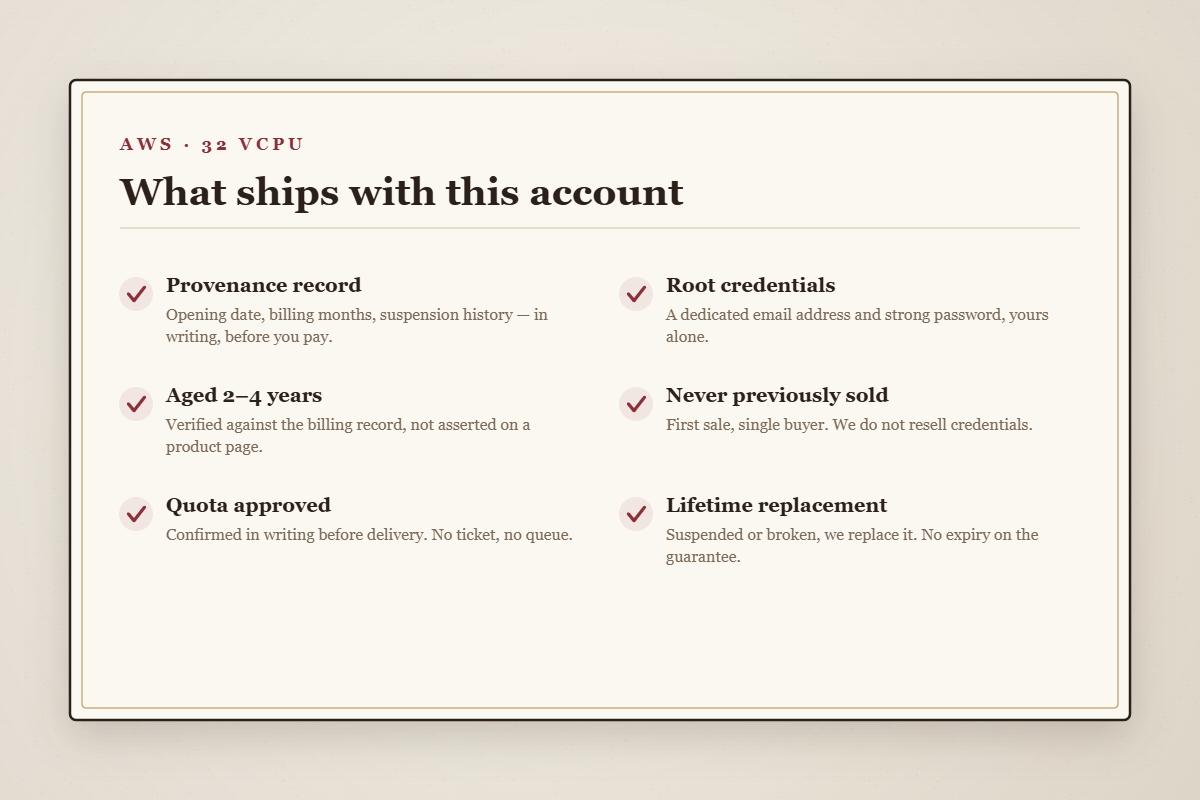
- A written provenance record — opening date, billing months, suspension history, prior-ownership status — shown before you pay.
- Root credentials — a dedicated email address and strong password, yours alone.
- A 32 vCPU quota approved in writing before delivery. No ticket, no queue.
- Never previously sold — first sale, single buyer.
- Console and billing access, with spend visible from your first login.
- Bedrock and SageMaker enabled, skipping a separate approval queue.
- Lifetime replacement, with no expiry, written into the order.
What 32 vCPU runs
Your quota is a concurrency ceiling — a cap on what may run at the same instant, not a monthly allowance. At 32 vCPU that comfortably covers a production application and API, a database and cache, several workers, a useful staging environment, and CI runners that are not fighting your live service.
If you are training models, running high-throughput analytics, or operating many parallel environments, step up to the 64 vCPU or 128 vCPU account instead.
Tiers and pricing
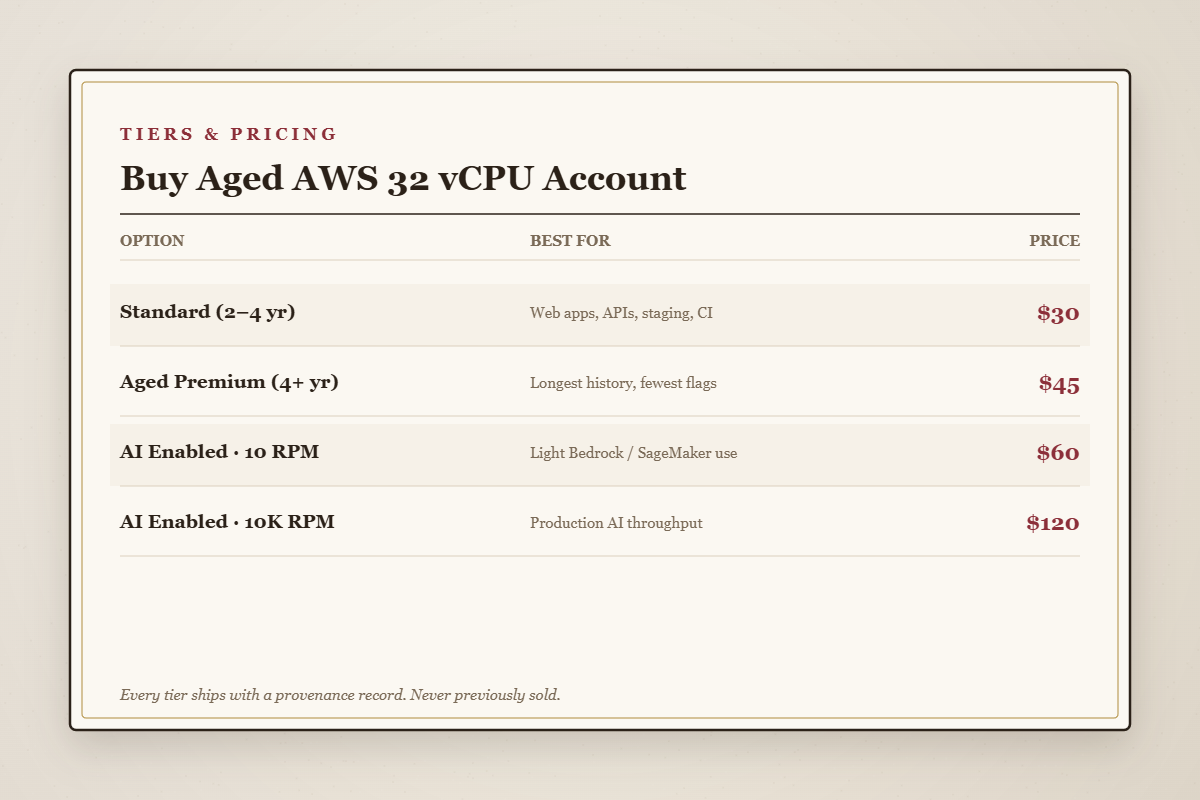
Standard (2–4 yr) — $30
A genuinely aged account, quota approved. The right choice for most buyers.
Aged Premium (4+ yr) — $45
The oldest accounts we hold, with the longest histories and the fewest flags. Worth the premium if your usage will look unusual; not necessary if it will not. On when age is worth paying for.
AI Enabled · 10 RPM — $60
Bedrock and SageMaker at light throughput — prototyping and low-volume inference.
AI Enabled · 10K RPM — $120
Much higher AI throughput for teams shipping to real users.
The provenance record
Every account on this page ships with a written record before you pay: the opening date, the length of billing history, the suspension record, the prior-ownership status, and the approved quota. You review it and decide with the facts in front of you — not after the money has moved. If we cannot verify an account’s history to our own standard, it does not ship, and you are not charged. Our full standard for what a record must contain is set out here.
Delivery
Around forty minutes, typically — slower than instant, because a person verifies the record against the billing history by hand before it ships. Credentials follow by email. If the account is ever suspended or fails, one message to the desk and we replace it, free and without expiry.
Enquiries
Can I see the provenance record before buying?
Yes. That is the point of it. Ask and we will send it before you commit.
Has this account been sold to anyone else?
No. Each account is sold once, to one buyer. The prior-ownership status is stated in the record.
How old exactly?
Typically 2–4 years on the standard tier, 4+ on Aged Premium. The exact opening date is in the record.
Does the quota work in any region?
No — quotas are per region. Tell us where you will deploy before ordering.
The first hour: keep what you bought
An aged account gives you a strong starting position. What you do in the first fifteen minutes decides whether you keep it.
- Change the password immediately and store it in a password manager. The one you were sent has sat in an email inbox.
- Enable multi-factor authentication before you deploy anything.
- Create a working user rather than operating as root day to day.
- Log in from one place. Accessing a freshly-purchased account from several countries in a week is the pattern that undoes even a well-aged account — it is precisely how resold-credential suspensions happen, and you do not want to recreate it yourself.
- Check the billing settings so you know what payment method is attached and what happens if it lapses.
Why we sell each account once
The most common way a bought account dies has nothing to do with its age or its quota. It is a seller handing the same credentials to several buyers, who then log in from several countries, triggering an automatic suspension that takes all of them down at once. A five-year-old account shared four ways dies as fast as a new one.
So we sell each account exactly once, and the prior-ownership status is stated plainly in the provenance record. It is the least glamorous thing we do and the most important. If you take one habit from this page, let it be asking every seller you consider: has this been sold to anyone else?
Related
Aged 64 vCPU · Aged 128 vCPU · Aged with credit. Browse the full aged AWS range and cloud accounts, or read why age predicts survival.
Disclaimer: OldAccs.com is an independent reseller and is not affiliated with, authorised by, or endorsed by Amazon Web Services, Inc.. All trademarks belong to their respective owners. An aged account improves your odds; it does not exempt you from the rules. You remain responsible for operating within the platform’s terms of service and for whatever you deploy.
Reviews
There are no reviews yet.