
Description
An aged AWS account with credit pairs two things that rarely come together honestly: a usable preloaded balance — $1,000 to $100,000 — and an account old enough to survive spending it.
The pairing matters. A large credit balance is worthless on an account that gets suspended in week three, and a fresh high-value account is exactly the profile risk systems distrust. Age is what protects the balance long enough for you to use it.
The expiry date, in writing, before you pay
AWS credit carries a time horizon, and most sellers in this trade will not mention it until after your money has moved. We state the expiry date in the provenance record, before you commit. Then we will be blunt about sizing: a $25,000 balance you cannot consume before it lapses is not a discount, it is a loss. If your realistic burn is modest, buy the smaller tier — we would rather sell you $5,000 you use than $25,000 you waste. More on the economics here.
What is included
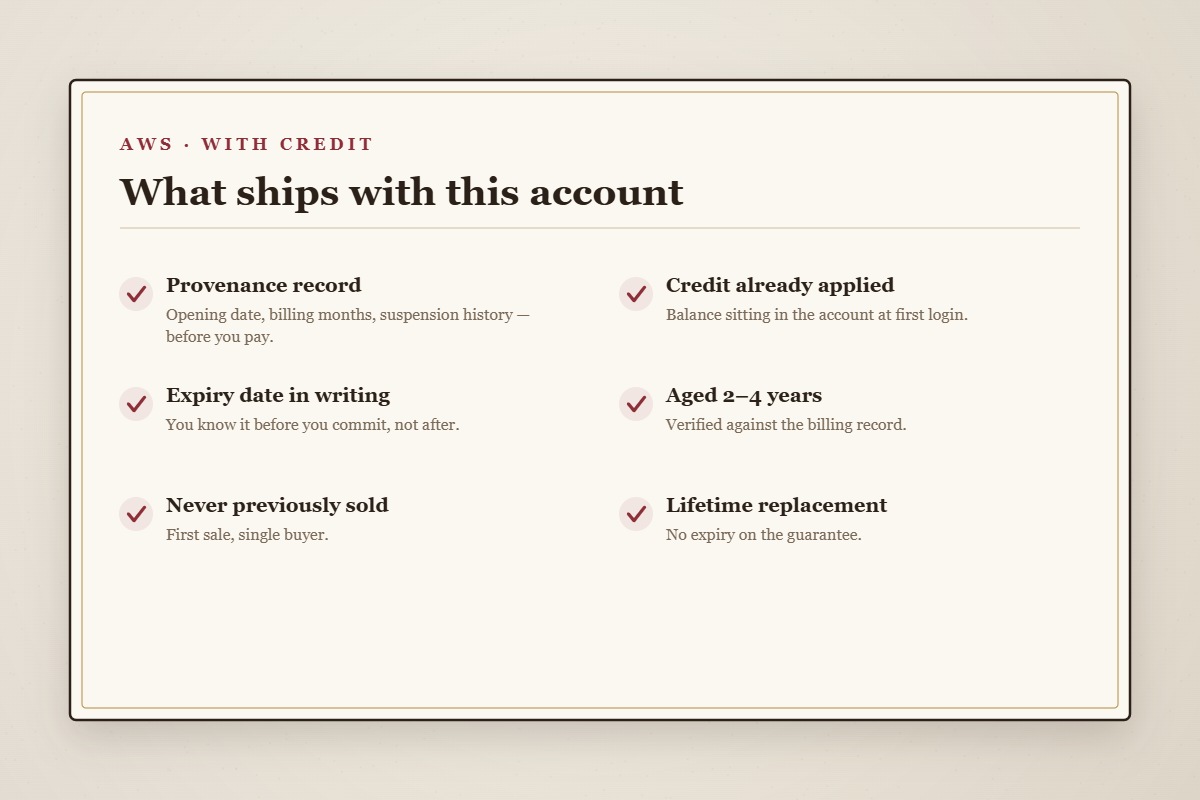
- A written provenance record — opening date, billing history, suspension record, and the credit expiry date — before you pay.
- The credit already applied, visible in the billing console at first login. Nothing to redeem.
- Root credentials — dedicated email and strong password.
- Never previously sold — first sale, single buyer.
- Bedrock and SageMaker enabled, since most credit buyers are here for AI work.
- Lifetime replacement, no expiry on the guarantee.
Credit lowers the bill; it does not raise the quota
Worth stating plainly. If your instances will not launch, credit will not help — you need a higher compute ceiling: 32, 64 or 128 vCPU. If they launch fine and the invoice is what hurts, this is your product. Heavy AI teams often need both.
Tiers and pricing
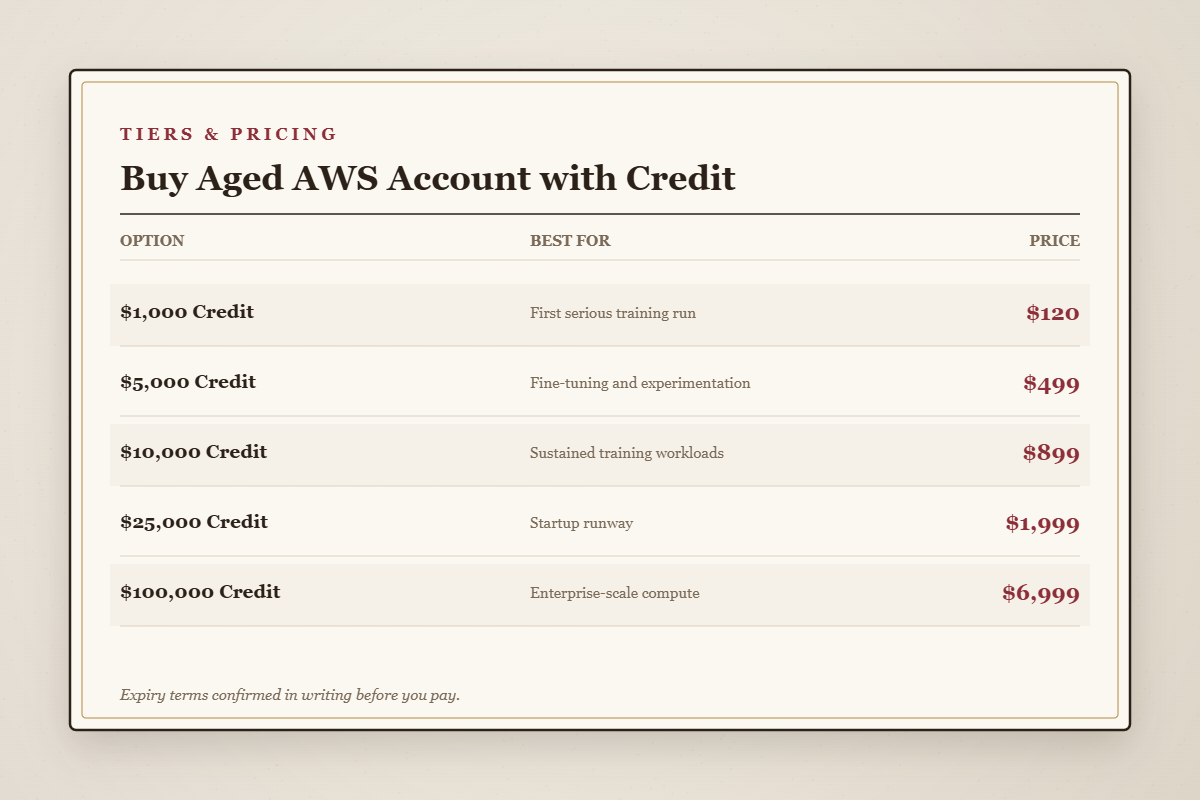
$1,000 Credit — $120
A first serious training run, or a proof of concept that needs real compute.
$5,000 Credit — $499
Where most applied-AI teams land.
$10,000 Credit — $899
Sustained training over several months.
$25,000 Credit — $1,999
Startup runway.
$100,000 Credit — $6,999
Enterprise-scale compute. Speak to us first.
The provenance record
Every account on this page ships with a written record before you pay: the opening date, the length of billing history, the suspension record, the prior-ownership status, and the approved quota. You review it and decide with the facts in front of you — not after the money has moved. If we cannot verify an account’s history to our own standard, it does not ship, and you are not charged. Our full standard for what a record must contain is set out here.
Delivery
Around forty minutes, verified by hand — including a check that the balance is present and the expiry is as stated. If the account is suspended or fails, one message to the desk and we replace it, free and without expiry.
Making an aged credit account last
An old account and a large balance are only worth pairing if you spend the balance well. Tag every experiment so you can see where the credit goes; use spot instances for anything that checkpoints; set alarms at 50% and 80% of balance; and watch the billing method underneath, because when credit runs out, billing reverts — and an unpaid balance is the commonest cause of suspension. Even a well-aged account is not immune to that, though its history buys it more patience than a new one would get.
The first hour: keep what you bought
An aged account gives you a strong starting position. What you do in the first fifteen minutes decides whether you keep it.
- Change the password immediately and store it in a password manager. The one you were sent has sat in an email inbox.
- Enable multi-factor authentication before you deploy anything.
- Create a working user rather than operating as root day to day.
- Log in from one place. Accessing a freshly-purchased account from several countries in a week is the pattern that undoes even a well-aged account — it is precisely how resold-credential suspensions happen, and you do not want to recreate it yourself.
- Check the billing settings so you know what payment method is attached and what happens if it lapses.
Why we sell each account once
The most common way a bought account dies has nothing to do with its age or its quota. It is a seller handing the same credentials to several buyers, who then log in from several countries, triggering an automatic suspension that takes all of them down at once. A five-year-old account shared four ways dies as fast as a new one.
So we sell each account exactly once, and the prior-ownership status is stated plainly in the provenance record. It is the least glamorous thing we do and the most important. If you take one habit from this page, let it be asking every seller you consider: has this been sold to anyone else?
Enquiries
Is the credit real, and can I see it?
Yes — applied before delivery and visible in the billing console at first login. We verify it is present before the account ships.
When does it expire?
The expiry date is stated in the provenance record before you pay. A balance you cannot consume in time is not a discount, and we will size it with you.
How old is the account?
Typically 2–4 years, with the exact opening date in the record.
Has it been sold before?
No. Once, to you.
Related
Aged 32 vCPU · Aged 64 vCPU · Aged 128 vCPU · aged AWS range · cloud accounts.
Disclaimer: OldAccs.com is an independent reseller and is not affiliated with, authorised by, or endorsed by Amazon Web Services, Inc.. All trademarks belong to their respective owners. An aged account improves your odds; it does not exempt you from the rules. You remain responsible for operating within the platform’s terms of service and for whatever you deploy.
Reviews
There are no reviews yet.