
Description
An aged Oracle Cloud account is worth more than its price for one blunt reason: it is out of review. The single most common way an OCI account fails is by landing in an administrative limbo it never leaves — and an aged account, with years of active history, is long clear of it.
Add the genuinely generous always-free ARM tier and the excellent value of Ampere instances, and an established OCI account is one of the quietly best purchases in this catalogue.
The OCI failure an aged account avoids
New Oracle Cloud signups routinely land “under review” — not rejected, not approved, simply frozen with no explanation and no route out. Some regions refuse new signups outright; card verification fails opaquely. An aged account has years of activity behind it and is long past that trap, with a record to prove it. The provenance document shows you the account’s standing before you pay. Why age predicts survival across every platform is set out here.
What is included
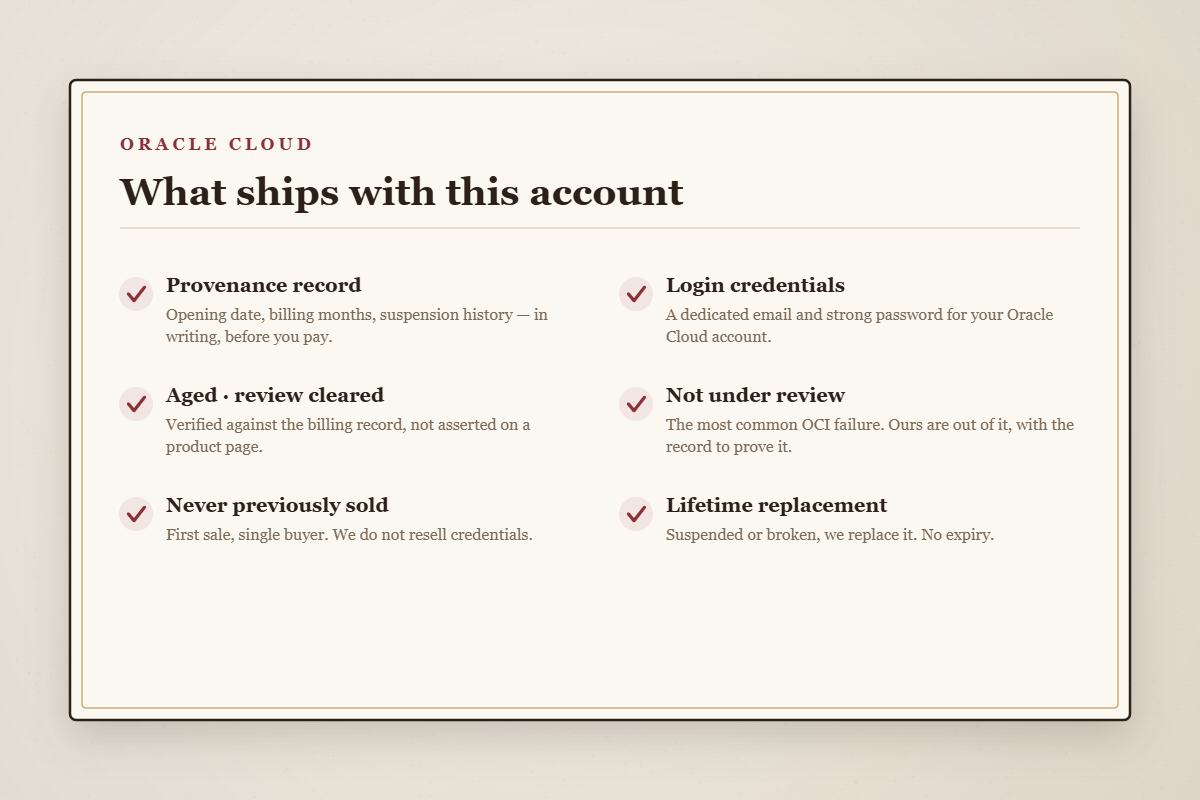
- A written provenance record — opening date, billing months, standing — before you pay.
- Login credentials — dedicated email and strong password.
- Long out of review — the OCI failure, already cleared, with the history to show it.
- ARM Ampere capacity available.
- Never previously sold — first sale, single buyer.
- Lifetime replacement, no expiry.
Tiers and pricing
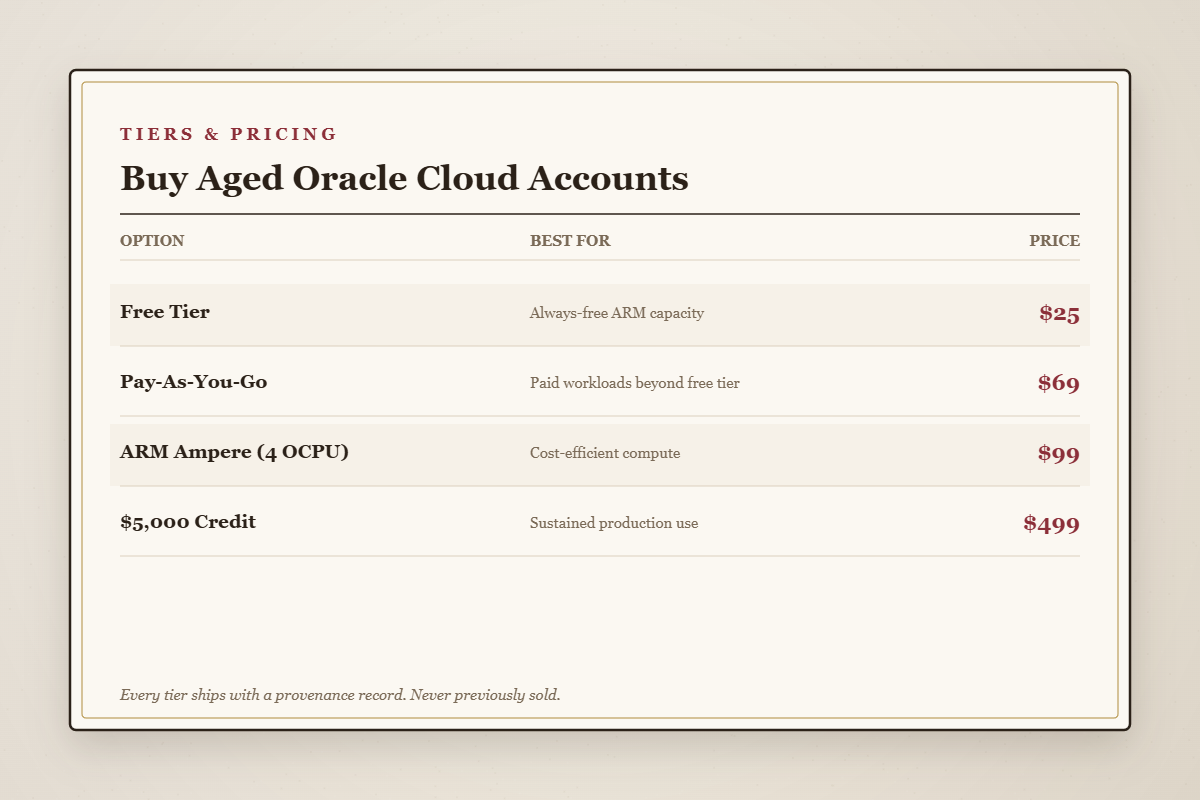
Free Tier — $25
An aged account with the always-free ARM allocation intact and reachable. For many buyers, the entire product.
Pay-As-You-Go — $69
Active billing beyond the free allocation.
ARM Ampere (4 OCPU) — $99
Configured for cost-efficient ARM compute.
$5,000 Credit — $499
Sustained production use.
The provenance record
Every account on this page ships with a written record before you pay: the opening date, the length of billing history, the suspension record, the prior-ownership status, and the approved quota. You review it and decide with the facts in front of you — not after the money has moved. If we cannot verify an account’s history to our own standard, it does not ship, and you are not charged. Our full standard for what a record must contain is set out here.
Honest limitations
ARM capacity is not always instantly available in every region — confirm yours with us. The ecosystem is thinner than a hyperscaler’s, and your software must run on ARM to capture the value. And the free tier has an edge you can fall off: exceed it and billing begins quietly, so set an alert on day one even though the account is free.
Ask for the record
You do not have to buy anything to see how we work. Name the platform and the age you want, and we will show you a genuine provenance record for an aged Oracle Cloud account — opening date, billing history and all — with no obligation. It is the fastest way to tell a real aged account from a word on a page. Write to the desk.
Delivery
Around forty minutes, verified by hand. If suspended, returned to review, or failed, message the desk for a free replacement, no expiry.
How people actually use it
The most common pattern is not a full migration. Teams keep the parts of their stack that genuinely need a managed catalogue where they are, and move the raw compute — CPU-bound workers, batch jobs, build farms — onto an aged Oracle ARM account, where the cost per core is dramatically lower and the account is old enough not to flinch at the load. It is simply declining to overpay for cores, on an account with the history to carry them.
The first hour: keep what you bought
An aged account gives you a strong starting position. What you do in the first fifteen minutes decides whether you keep it.
- Change the password immediately and store it in a password manager. The one you were sent has sat in an email inbox.
- Enable multi-factor authentication before you deploy anything.
- Create a working user rather than operating as root day to day.
- Log in from one place. Accessing a freshly-purchased account from several countries in a week is the pattern that undoes even a well-aged account — it is precisely how resold-credential suspensions happen, and you do not want to recreate it yourself.
- Check the billing settings so you know what payment method is attached and what happens if it lapses.
Why we sell each account once
The most common way a bought account dies has nothing to do with its age or its quota. It is a seller handing the same credentials to several buyers, who then log in from several countries, triggering an automatic suspension that takes all of them down at once. A five-year-old account shared four ways dies as fast as a new one.
So we sell each account exactly once, and the prior-ownership status is stated plainly in the provenance record. It is the least glamorous thing we do and the most important. If you take one habit from this page, let it be asking every seller you consider: has this been sold to anyone else?
Why buy aged rather than new?
An Oracle account is free to open — if you can get through the review, which many people cannot. What you are buying is an account that already did, years ago, and stayed clear. That is not a convenience you can manufacture; it had to actually happen and be maintained. The provenance record turns it from a claim into a fact you can check before paying.
Enquiries
Is always-free really free forever?
Subject to Oracle’s terms and the resources remaining in use, yes. Not a 12-month trial.
Has the account been sold before?
No. Once, to you.
What if it returns to review?
Free replacement — that is exactly what the guarantee covers.
Related
Aged Hetzner · Aged DigitalOcean · Aged Linode · cloud accounts · aged AWS range.
Disclaimer: OldAccs.com is an independent reseller and is not affiliated with, authorised by, or endorsed by Oracle Corporation. All trademarks belong to their respective owners. An aged account improves your odds; it does not exempt you from the rules. You remain responsible for operating within the platform’s terms of service and for whatever you deploy.
Reviews
There are no reviews yet.